My main Claude Code session writes almost no code
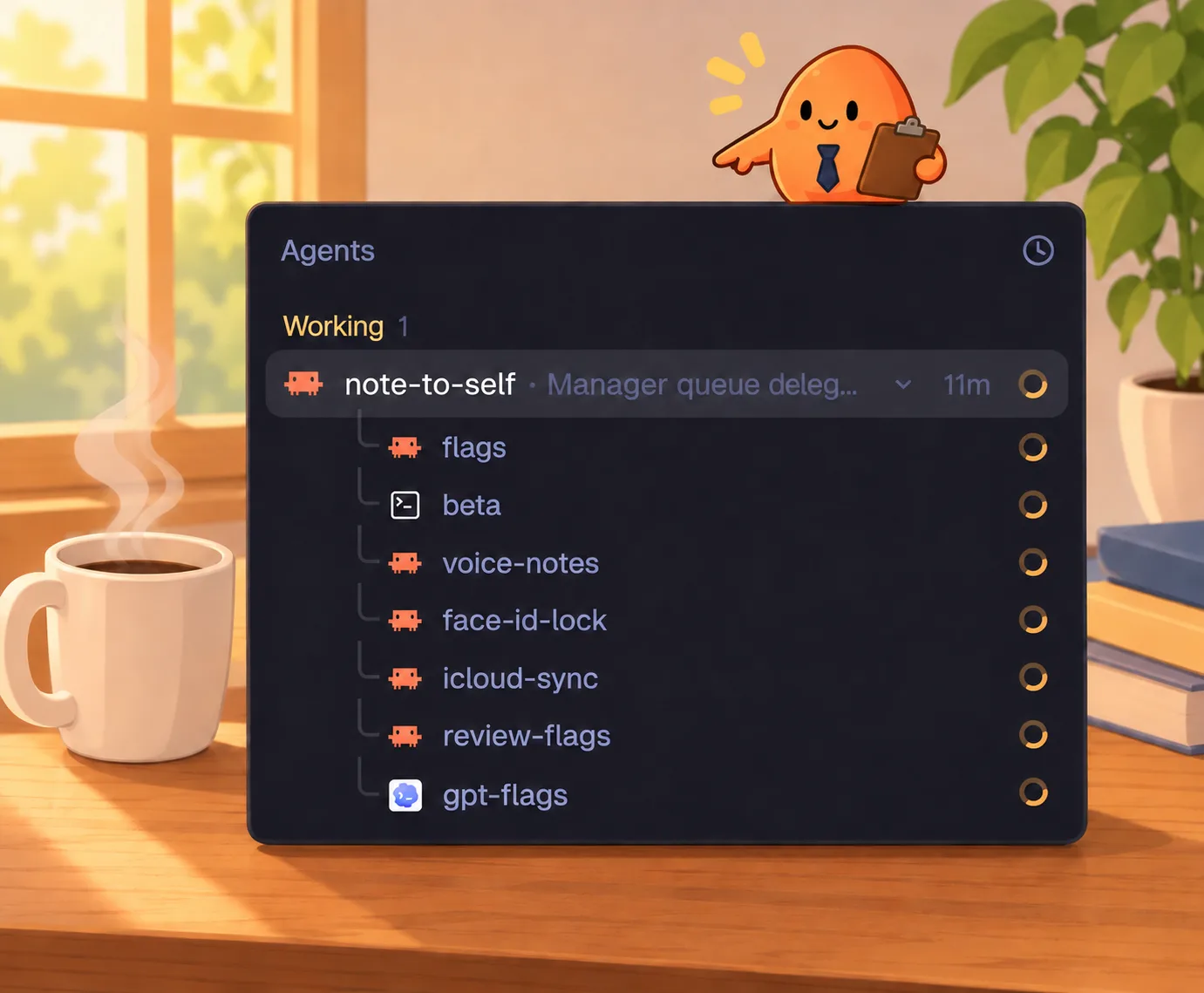
For the last week my main Claude Code session has been a manager. It plans the work, briefs other Claude Code agents, checks what they deliver, merges and ships. It writes almost none of the code itself.
- 37 TestFlight betas of Note to Self in 5 days, builds 12 to 48.
- In the 5 days before, I shipped 9.
- The manager started 84 agents, and they sent it 303 messages.
The whole manager is one Markdown file of 129 lines.
Why your main session shouldn’t write the code
When your main session writes the code, you are the manager. You watch it work. You check every “done”, merge, ship and start the next thing. You repeat the same rules to every new session, because each one starts from zero.
The manager takes that job. It doesn’t trust a “done”: it checks the commits, the tests, the proof video and a Release build itself. Every rule I give it goes into the brief that every later agent reads, so I say it once.
My job is to approve plans and try the betas on my phone.
Only 44 of the manager’s 2,057 tool calls in those 5 days were file edits, about 2%, and most of them were briefs and notes. My other sessions sit at 11%. It isn’t pure: a few times it fixed a Release build or a test file itself.
The setup
One Claude Code session is the manager.
Each feature goes to its own Claude Code agent, in its own git worktree, running in parallel where two items can’t step on each other.
The agents run in Herdr, a terminal app for coding agents.
Its hc CLI starts agents, passes messages between them and waits on them, and hc --skill prints a manual that teaches the manager all of it.
Every feature goes through the same pipeline:
- The agent writes a plan. I approve it.
- It builds, with tests and a simulator video as proof, committing each logical chunk.
- It reviews its own diff with
/code-review, and GPT reviews it as a second model. - It reproduces every finding first, and fixes the real ones.
- The manager checks the proof, merges and ships a TestFlight beta.
Why separate agents instead of subagents
Subagents are great for a quick, bounded question. A feature that takes an hour of building, testing and reviewing needs more:
- A full session can start its own subagents, so it can run
/code-reviewthe way I would. - I can open any agent’s terminal, read it, and type into it.
- The manager only sees short messages (“plan ready”, “committed”, “done”), so its context stays small across a queue of 20 features.
- Agents keep running when the manager restarts or compacts, and I can stop one without touching the rest.
The cost is plumbing: a terminal app, messages between sessions, and cleaning up terminals and worktrees.
Every failure became a rule
The skill had 9 commits in its first 2 days, and nearly every one came from something that broke:
- Agents sat waiting on permission prompts nobody was watching. Now every agent runs in auto mode.
- Agents ran the whole UI suite for a one-line change. Now they run only the affected test classes.
- Agents only built Debug, and a Release beta failed to archive. Now they build Release before they report done.
- The manager merged three features without a beta. Now a beta follows every feature, and a failed beta blocks the queue.
- A sync feature ran a whole day, with about 35 review findings, most of them caused by the feature’s own earlier fixes. Now behavior-heavy work starts with a spec, and agents stop and ask when a fix needs new machinery.
The system gets better each time something breaks, because the fix lands in the brief every later agent reads.
Three Herdr details that cost me time
hc senddelivers a chat message to another agent, so a slash command sent that way doesn’t run. Slash commands needhc keys.- When an agent’s auto mode blocks something, an approval relayed by the manager doesn’t count as my consent. The fix is Remote Control on that terminal, so I approve it myself from my phone.
- The manager may only clean up agents it started itself, never my own terminals.
Make it yours
The skill is plain Markdown, so changing it means editing a sentence. Mine has iOS rules (simulators, Release builds, TestFlight), and yours will have your own. Swap the beta for a deploy, the simulator video for a screenshot, GPT for whatever second reviewer you trust. Every time something breaks, add one line.
Or start smaller than my skill. Start Claude Code in a Herdr session and paste this:
You’re the manager and you write no code. Run
hc --skilland follow it. For each item in my list, start a Claude Code agent in auto mode, in its own git worktree. Each one plans first and waits for my OK. When one is done, check it, merge it, start the next.
The full skill, with its templates and the review script, is on GitHub. Fork it, delete what doesn’t fit your project, and add your first rule the first time something breaks.